

 NILAN EDITOR
The ED Challenges Staff on Excellent Service Delivery
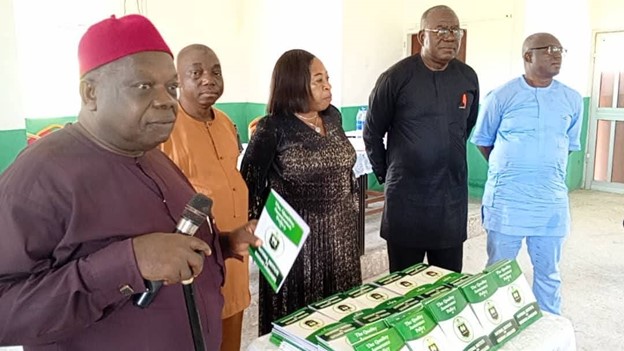
The National Institute for Nigerian Languages (NINLAN), Aba, has launched a service delivery booklet for its staff. The handbook, titled The Quality Assurance Policy of the National Institute for Nigerian Languages, was presented to all members of staff during a one-day training session jointly organised by the Service Compact (SERVICOM) and Quality Assurance Units of the Institute. The event was chaired by the Executive Director of the Institute, Professor Ogbonna Onuoha.
While presenting the Quality Assurance Policy, Professor Onuoha challenged the staff to embrace the principles promoted by SERVICOM and Quality Assurance, and to render excellent service to the Institute. He urged both academic and non‑teaching staff to ensure that their services meet the highest standards.
He stated that NINLAN, as the apex authority in the research and teaching of Nigerian languages, deserves the highest level of dedication, discipline, and diligence from its workers. According to him, this is necessary to make the Institute live up to expectations.
The Executive Director explained that the presentation of the policy booklet and the accompanying training were aimed at launching the Institute into a new era, “when we really work to restore the glory of the Institute through SERVICOM and Quality Assurance.”
In a lecture titled “Understanding SERVICOM/Quality Assurance: Cultivating Quality Service Delivery Culture in NINLAN,” the Institute Librarian, Professor Cyprain Ugwu, defined good service delivery in terms of service excellence, timeliness and responsiveness, honesty and transparency, accountability, and customer‑focused service. In his words, SERVICOM means “promising to serve people well and doing everything possible to keep that promise… putting people first by providing timely, fair, and honest service.”
Professor Ugwu described Quality Assurance as “doing things well and checking regularly to be sure they are done properly. It is about making sure that teaching, learning, services, operations, and engagement with communities meet the highest standard of excellence.”
Ugwu’s paper specifically tasked the Institute’s academic staff to “prepare their lectures well, teach using good methods, mark fairly, and attend classes on time.” For non‑teaching staff, the expectation is to “give timely and accurate service to students and their colleagues.” He also encouraged the management to follow the rules and to carry everyone along.
Professor Ugwu urged participants in the training to practise continuous learning and improvement on the job. He advised them always to look for ways to do things better and not to feel complacent with just being good enough.
Other resource persons at the training were Professor Nkechi Ohaike (Focal Officer of SERVICOM), Dr. Joy Chikezie (Dean of the Postgraduate School and Coordinator of Quality Assurance), and Professor Ugochi Ikonne (Dean of Education and SERVICOM’s Complaints Desk Officer).
Speaking on “SERVICOM Principles and Mandate for Effective Service Delivery,” Professor Ohaike outlined the service principles propagated by SERVICOM and urged the Institute’s staff to imbibe and observe them. She said that the SERVICOM Unit under her leadership would work to ensure that things are done better by every staff member. She admonished the staff to master all the rules and regulations and demonstrate due compliance, including coming to work punctually and regularly, and rendering quality service in their respective areas of assignment.
The SERVICOM Focal Officer also encouraged the provision of working tools and a conducive work environment for staff. She noted that this would help avoid what she called “management‑induced” deficiencies in service delivery.
Dr. Joy Chikezie spoke on “Quality Assurance Frameworks and Policies.” She outlined what Quality Assurance entails and emphasised its great significance in improving the standard of service expected from the Institute’s staff.
Professor Ugochi Ikonne took participants through the history of SERVICOM operations in the Institute. She traced its creation by the second Executive Director, Professor Ben Elugbe; its revival by the fourth Executive Director, Professor Obiajulu Emejulu; the near delisting of the Institute’s SERVICOM Unit by Abuja due to inactivity; and the breath of life reinjected into it by the current Executive Director, Professor Onuoha. She noted that Professor Onuoha appointed the present team of officers, sponsored them to a SERVICOM national workshop, and organised this historic and crucial training for all staff in collaboration with the Quality Assurance Office.
The training, the first of its kind, was attended by all staff, including the Registrar, Mrs. Charity Ijoma; the Bursar, Mr. Kolawole Aliu; and the Director of Works, Architect Emeka Izuwah.

Comments are closed